Families calling us for the first time often ask the same question in different forms: "Is SimranShri a nasha mukti kendra?" The honest answer is yes — and no. SimranShri is a government-accredited medical rehabilitation centre; the Hindi label "nasha mukti kendra" applies, but the category covers facilities with very different clinical capabilities.
This article lays out the real differences — not marketing comparisons, but the clinical and practical differences that matter when you are deciding where to admit a family member.
What "nasha mukti kendra" actually means
The phrase translates roughly to "addiction-release centre." In practice, it is an umbrella term covering state-run addiction facilities, NGO-operated centres, informal faith-based or peer-support facilities, and government-accredited medical rehabilitation centres. Regulation varies substantially; many informal facilities operate without medical credentials.
The three categories families are choosing between
1. Government / state-run nasha mukti kendras
Run or funded by state governments or the national social-justice ministry. Low or no direct cost. Often overcrowded, with long admission waits. Quality varies substantially by state and location. Medical supervision is often limited to daytime hours. Appropriate for families with no other option, but rarely first-choice for families who can afford alternatives.
2. NGO and informal nasha mukti centres
Non-profit centres, sometimes faith-based, typically operating without medical credentials. Strong on peer support, 12-step framework, and community. Weak on medical detox — unsupervised alcohol or benzodiazepine withdrawal in these settings is genuinely dangerous. Affordable. Right for mild dependency in stable patients; not appropriate for severe alcohol, opioid, or poly-substance dependency.
3. Accredited private medical rehabilitation centres
Government-licensed medical facilities with on-site psychiatric leadership, evidence-based protocols, and structured programmes. Higher cost. Full medical detox capability. Integrated family therapy and 12-month aftercare. This is the clinical standard for moderate-to-severe dependency and where families who can afford it typically end up.
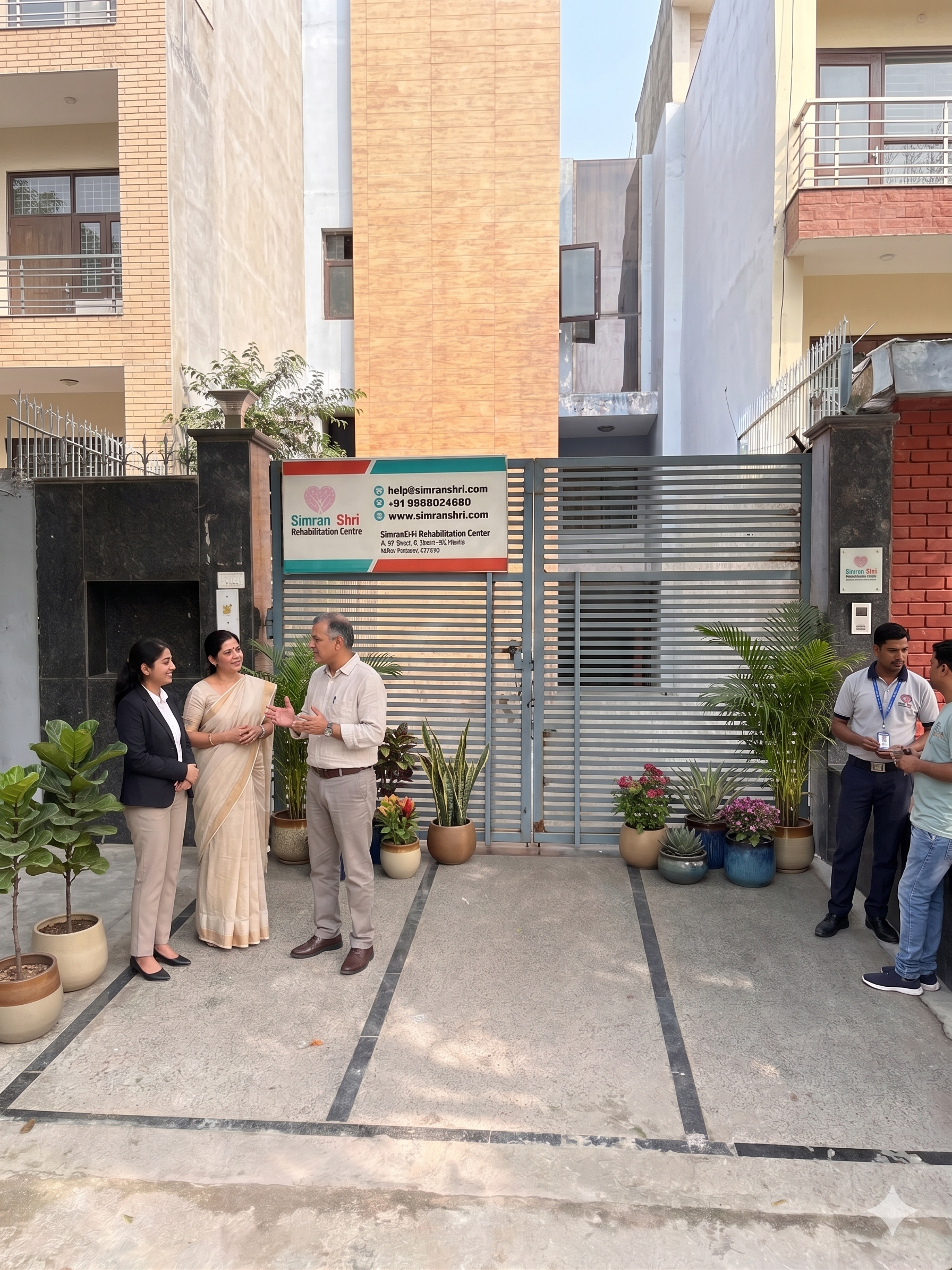
SimranShri is a government-accredited private medical rehabilitation centre — category 3. Psychiatrist-led, evidence-based, with structured 12-month aftercare.
Cost honestly compared
State-run centres cost little or nothing. NGO nasha mukti kendras charge from zero to moderate fees depending on the centre. Accredited private medical rehabilitation typically costs substantially more — because the inputs are genuinely different: on-site psychiatrist, medical detox medications, qualified psychologists, structured aftercare.
The right framing is not "cheaper vs more expensive" but "what are you paying for?" At a state-run facility, you are paying for basic board, peer support, and limited clinical oversight. At an accredited medical centre, you are paying for 24×7 psychiatric supervision, evidence-based therapy, and a 12-month aftercare apparatus. The outcomes differ accordingly.
Medical supervision — the single biggest variable
For families deciding between options, we argue this is the most important question: is there a qualified psychiatrist on-site throughout acute withdrawal?
Alcohol withdrawal can cause seizures and delirium tremens. Benzodiazepine withdrawal can cause seizures. Opioid withdrawal, though rarely fatal, is physically overwhelming and drives near-universal relapse without medical support. Centres without on-site psychiatric leadership cannot safely manage severe cases in these categories.
- Ask specifically: "Is there a psychiatrist on-site, or on-call?"
- Ask: "Who administers detox medications?"
- Ask: "What happens if the patient has a medical emergency at 2 AM?"
- Ask: "Can you share the facility’s government-accreditation documentation?"
- If the answers are vague for severe dependency cases, the centre is the wrong fit.
Aftercare and relapse outcomes
Most state-run and informal nasha mukti centres discharge patients with a handshake and a meeting list. Accredited private medical centres typically include structured 12-month aftercare: outpatient counselling, AA/NA integration, family sessions, medication continuation, relapse-warning-sign monitoring, fast-track re-admission.
The aftercare phase is where long-term outcomes are actually determined — relapse risk is highest in months 2 to 6 post-discharge. A centre that does not own that window is only addressing half the problem.
How to actually decide
- Assess severity honestly. Heavy daily alcohol use, opioid dependency, benzodiazepine dependency, poly-substance cases, or history of withdrawal complications = medical-grade facility required.
- Verify accreditation. Ask for documentation. Real government-accredited centres have it and share it without friction.
- Confirm on-site psychiatric leadership, not visiting consultants.
- Ask about aftercare. If the answer is "we give them AA meeting numbers," that is not aftercare.
- Visit before admitting. Walk through the facility. Meet the clinical team. Ask every question.
Our Admissions page walks through the clinical admission pathway; our Facilities page shows the Noida centre; our Why SimranShri section on the homepage compares our clinical approach to non-medical nasha mukti models. Call the admissions desk if you want a specific question answered.
- "Nasha mukti kendra" covers very different facility types — state-run, NGO, informal, and accredited medical. Clinical capability differs enormously.
- For mild dependency in stable patients, community-style nasha mukti facilities can help. For severe alcohol, opioid, or benzodiazepine dependency, they are clinically inadequate.
- On-site psychiatric leadership is the single most important quality variable. Ask about it directly.
- Cost differences reflect real clinical inputs — medical detox, psychiatrist, therapy, aftercare — not markup.
- Aftercare is where long-term outcomes are determined. Centres without structured aftercare cannot claim sustained-recovery outcomes.
- Visit before admitting. Verify accreditation. Meet the clinical team.