
One of the most common admissions scenarios we work with is a family whose loved one refuses to accept they have an addiction. The person is drinking or using at a severity that everyone else in the household can see, but they are either in flat denial ("I don't have a problem") or in negotiated denial ("I can handle it myself, I don't need rehab"). The family is stuck — they cannot drag an adult into treatment, and simple conversation has not worked.
A structured family intervention is the tool for this situation. Done well, it is one of the most powerful interventions in addiction care. Done badly, it causes lasting damage. This piece explains how we run it.
When a family intervention is the right tool
A structured intervention is appropriate when all of the following are true:
- Clinical dependency is clearly present — this is not for heavy social use or early-stage concern.
- The person has refused direct conversation about treatment or has agreed in words without following through.
- The family is prepared to follow through on specific consequences if the person declines treatment.
- Key family members are aligned and can present a united front.
- There is no immediate clinical emergency — emergencies go directly to admission through our emergency pathway, not through an intervention meeting.
If any of these are not true, the intervention pathway is either premature or wrong. Our admissions counsellors help families assess this before committing to the process.
What a structured intervention is not
A serious intervention is not the cinematic version where the family ambushes the person and shouts at them. That approach often increases resistance, damages relationships, and fails to produce admission. It is also not an ultimatum session where the family arrives with a list of grievances and an exit door.
A structured intervention is a calm, facilitated, pre-planned conversation with specific content and specific goals. It is serious but not hostile. The person being addressed is treated as a loved one in crisis, not as a defendant on trial.
The pre-intervention work
A family intervention is 90% preparation and 10% meeting. The preparation work typically takes 1-3 weeks.
Step 1: Family consultation and assessment
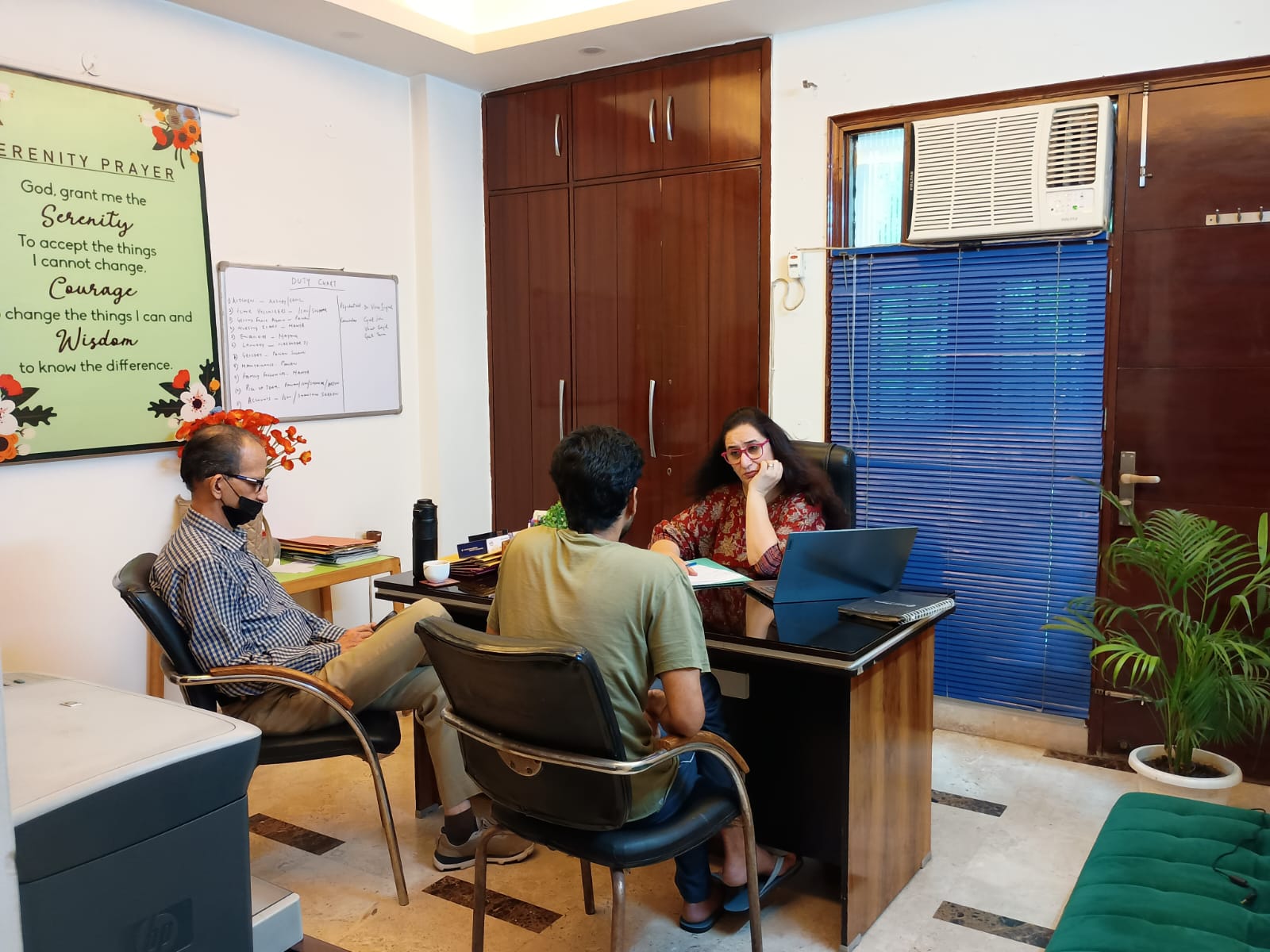
The family meets with our intervention counsellor — usually without the person. The consultation covers the substance use history, current severity, past treatment attempts, family dynamics, and the question of who should participate in the intervention itself. Not every family member should be in the room. The ideal group is typically 4-7 people who are close, credible, and emotionally steady.
Step 2: Bed readiness at SimranShri
Before the intervention meeting happens, we confirm a bed is ready at SimranShri and the admission pathway is clear. If the intervention succeeds in producing consent to treatment, we want the person to be admitted that day — not given a week to change their mind. Same-day transport from the intervention location to SimranShri is part of the plan.
Step 3: Letter writing
Each participating family member writes a letter to the person. The letter has a specific structure: a statement of love, specific factual observations of the addiction's impact (not interpretations, not accusations), a specific ask that the person accept treatment today, and a specific consequence if they decline. The letters are drafted, reviewed with the counsellor, revised, and rehearsed.
Step 4: Consequences must be real
The consequences each family member names must be ones they are actually willing to enforce. Empty threats are worse than no threat. Examples of real consequences: a spouse moving out until treatment is complete, a parent stopping financial support, an employer withdrawing tolerance for missed work, an adult child restricting grandparent access to young children until sobriety is established. Consequences are individual — each family member names theirs.
Step 5: Rehearsal
The family rehearses the meeting with the counsellor. Who sits where. Who speaks first, second, third. What happens if the person walks out. What happens if the person agrees. What happens if there is an angry outburst. Rehearsal prevents the intervention from collapsing into unstructured argument on the day.
The intervention meeting itself
The meeting is typically held at home or at a neutral location — not at a restaurant, not with alcohol present. The person is usually asked to come for an unrelated reason and the family is already seated when they arrive. This prevents avoidance but it is not an ambush — the counsellor facilitates and the tone is controlled.
Opening
The counsellor opens, introduces themselves, explains that the family has asked for this conversation because they are worried. The counsellor asks the person to listen without interrupting for the next twenty minutes, and assures them they will have time to respond.
Letters
Each family member reads their letter. The letters are specific, emotional, and controlled. They end with the specific ask and specific consequence. The person being addressed is asked to listen, not respond.
The ask
The counsellor consolidates the asks into one clear request: "We are asking you to come with us to SimranShri today. Your bed is ready. We will drive you there now. We will visit you. We will support you through the treatment. We are asking for your answer in the next few minutes."
The response
The person responds. Common responses and how we handle them:
- "Yes, I'll go." — Proceed immediately to transport. The counsellor accompanies the family. Admission happens within hours.
- "Yes, but not today. Let me wrap up some things first." — The counsellor and family gently decline. Today is the ask. Delay is how intervention momentum is lost. The consequences stand if the answer is no today.
- "No, I don't have a problem." — Each family member restates their consequence. The meeting ends with the consequences taking effect. The counsellor leaves the door open for the person to call back in 24 hours and accept treatment.
- "I'm angry with all of you." — The counsellor validates the emotion without backing down from the ask. Anger is common and does not mean the intervention has failed.
After the intervention — either outcome
If the person accepts treatment, admission proceeds that day. The family's work is not over — they transition into the family therapy component of the treatment, which begins in week three of the patient's stay.
If the person declines treatment, the family must follow through on the stated consequences. This is the hardest part of the process and the part most likely to be undone by well-meaning family members who soften within days. Softening teaches the person that the consequences are negotiable, which reduces the likelihood of any future intervention working. The counsellor supports the family through this phase and is available if the person changes their mind.
In our experience, a substantial majority of well-prepared interventions produce same-day admission. Of those that produce refusal, a meaningful fraction produce admission within 1-4 weeks as the consequences take effect and the person reconsiders. A small fraction of interventions produce no admission and prolonged stand-off. Even in that case, the family is often in a substantially better position than before — the denial has been named, the enabling has stopped, and the family has some control back.
Our intervention counsellors offer a free 30-minute consultation to help you assess whether a structured intervention is the right pathway, and to explain the preparation process. Call our admissions line and ask specifically for the intervention pathway.
- A structured family intervention is the pathway when clinical dependency is clearly present and the person is refusing to accept it. It is appropriate when the family is aligned and prepared to follow through on consequences.
- A serious intervention is not an ambush or a shouting match. It is a calm, facilitated, pre-planned conversation with specific content and goals.
- The work is 90% preparation: family consultation, bed readiness, letter writing, consequence planning, rehearsal. The meeting itself is 10% of the process.
- Consequences named by each family member must be real and enforceable. Empty threats are worse than no threat.
- The ask is for admission today, not next week. Delay is how intervention momentum is lost.
- A substantial majority of well-prepared interventions produce same-day admission. Even refusals often produce admission within weeks as consequences take effect.